
Economic impact of digital including in the UK – Good Things Foundation – July 2022
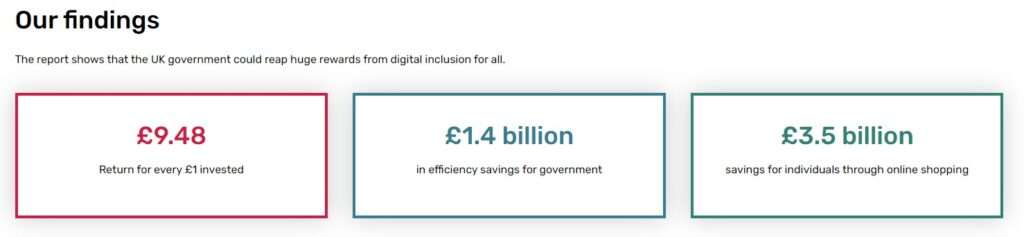
This report, launched by Good Things Foundation, sets out the economic impact of digital skills and inclusion in the UK. The report finds that investment of £1.4 billion could reap economic benefits of £13.7 billion for UK plc. This is £9.48 return for every £1 invested.
Investment in improving the digital skills of those who are digitally excluded in our society will lead to significant benefits for the UK economy. Understanding the scale of these economic benefits should be critical for those making decisions about policy and investment, at a national, regional and local level. This paper sets out the economic case for investing in interventions to help digitally excluded people build their basic digital skills. It is based on analysis by Cebr (Centre for Economics and Business Research), commissioned by Good Things Foundation in partnership with Capita.
Digital Inclusion: Is it key for the UK’s economic growth?
Digital skills are essential for most of us in our everyday lives – and the Covid 19 pandemic has significantly changed the way we all live and work. It led to an acceleration in the adoption and application of digital technology which has been transformative for both people and businesses – and the majority of us have used technology to reduce isolation to access up-to-date health information and to help our children to learn.
However, the less familiar story of the pandemic is that although digital exclusion has reduced overall, the divide itself has worsened, with the most vulnerable lagging further behind. There was a large increase during the pandemic in the numbers of people that only had partial digital skills, and there is evidence that isolation and lack of consistent support meant some lost or forgot those skills that they had previously gained – particularly amongst over 65s. In addition, there are 2 million households that struggle to afford internet access in the UK today. This will only increase as the impacts of the increased cost of living begins to bite.
The pandemic didn’t create the digital divide – but it did expose and exacerbate it. Fixing the digital divide is an urgent priority. We need to act now and we need your help to take the necessary steps to overcome digital exclusion, overcoming all the barriers including skills, motivation and confidence, and access. Without further additional intervention, 5.8 million people are estimated to remain digitally excluded by the end of 2032 – 3.7 million in the over 75s age group.
Digital inclusion remains an urgent issue in the UK. It is crucial for the UK’s economic success, and for the Government’s ambitions to level up, as this report sets out. Giving everyone in the UK the digital skills they need to not only survive, but to thrive too, will be crucial to the UK recovering from the effects of the pandemic, as well as weathering the storms of the cost of living crisis in the UK.